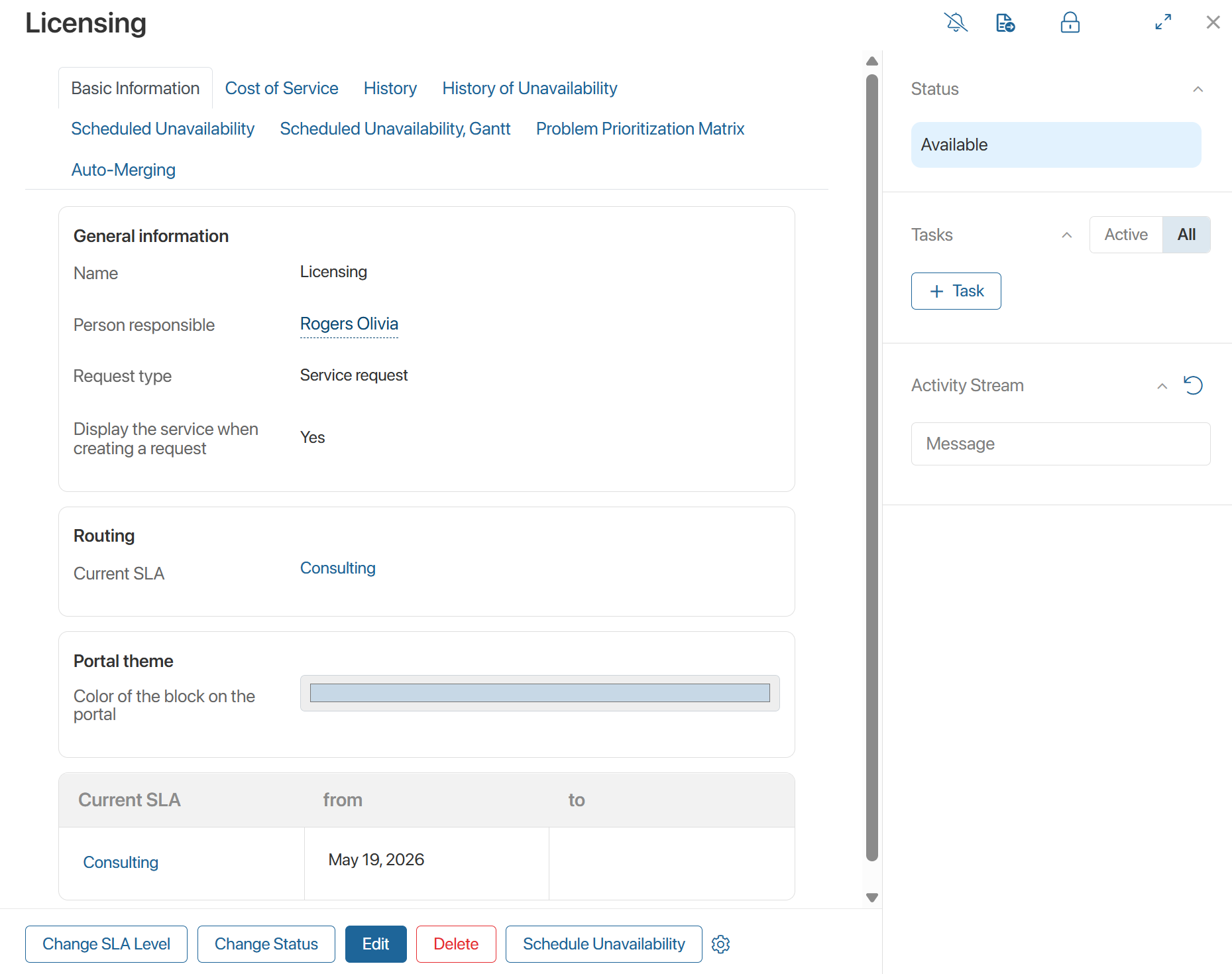
The service page displays essential information about a service. The page consists of a sidebar and the following tabs: Basic Information, Cost of Service, History, History of Unavailability, Scheduled Unavailability, Scheduled Unavailability, Gantt, and Problem Prioritization Matrix.
You can:
- Modify the SLA standard.
- Edit or delete a service.
- View and change the service status, as well as schedule a period when the service will be unavailable for creating requests. For more details, see the Mark a service and a service catalog unavailable article.
- Send the service for review or approval. These actions are performed similarly to documents. For more details, see the Ready-made document routes article.
Basic Information tab
This tab displays the basic service details: description, responsible employee, current service terms (SLA) and their validity period, as well as the assigned support level.
If the service is linked to others, its page will show references to parent or child services.
Cost of Service tab
Here, you can view:
- Contracts for providing the service.
- The number of processed requests per contract and the total revenue generated.
- The service cost according to the price list.
History tab
This tab shows the action history for the service. The information is presented in a table with the following columns:
- Action. Description of the recorded action. For example, status change or item update.
- Attribute. The service parameter that was modified.
- Value Before, Value After. The previous and updated values of the modified attribute.
- User. The employee who made the change.
- Date. The date and time of the change.
The data on the tab is displayed if the system administrator has enabled and configured the History of ServiceDesk Apps module.
To filter the data, click the  button. Set filtering parameters: select actions, users, mark item properties, or set a date. Click Apply.
You can export data in .xlsx or .pdf format. To do this, click the export  button, select the format, and click Generate.
History of Unavailability tab
This tab displays a table with information about the reasons and times when the service was marked as Unavailable or Partially unavailable.
Scheduled Unavailability and Scheduled Unavailability, Gantt tabs
Here, you can review planned periods when service availability to clients will be restricted.
For example, if an employee handling internet connection equipment repairs is on leave, you may decide to suspend the service. During the scheduled period, the service status will automatically change, and a warning will appear on the request creation form indicating that the service is unavailable.
Information is displayed on the following tabs:
- Scheduled Unavailability. The table lists service unavailability periods, their durations, and reasons.
- Scheduled Unavailability, Gantt. The periods when service delivery is limited are presented sequentially in a diagram format.
For more details, see the Mark a service and a service catalog unavailable article.
Problem Prioritization Matrix tab
On this tab, you can view the criteria used to assign a priority to a problem for this service. The table lists urgency and impact values along with their corresponding priority levels.
When registering a problem, the user selects a service, specifies urgency and impact, and the priority is assigned automatically according to the matrix.
Change the SLA level
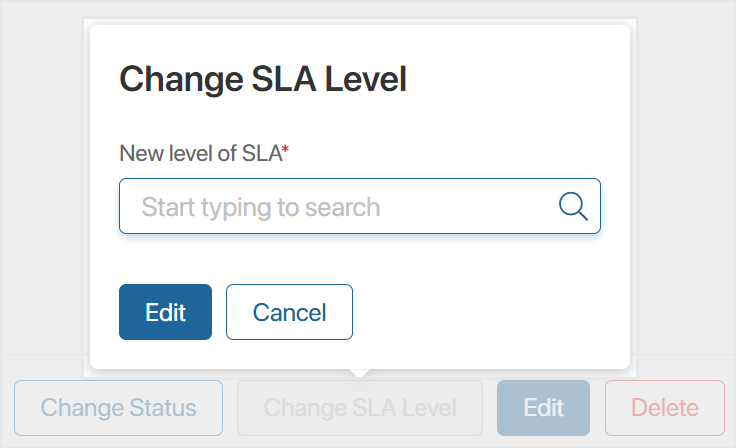
To set a different SLA level for a service, click Change the SLA Level on its page. In the window that opens, select a new level and click Edit.
Edit or delete a service
Users with editing permissions can modify service parameters such as name, description, responsible persons, support level, and parent service. To do this, open the service page and click Edit.
After making changes, click Save.
To delete a service, click the corresponding button on its page.