To add a new service:
- Go to the Services app and click +Service.
- In the window that opens, go to the Main tab and fill in the fields:
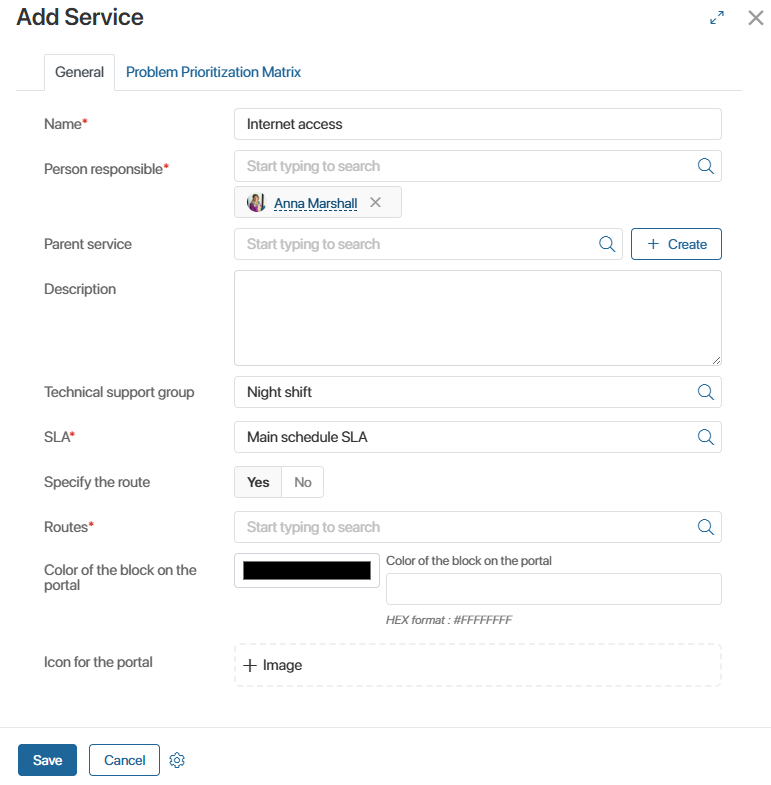
- Name*. The name of the service being provided.
- Description. Detailed information about the service.
- Person responsible*. One or more users who will handle requests for this service.
If one responsible user is specified, they are automatically assigned when a request is created for this service. If multiple responsible users are set, new requests are assigned to the operator with the lowest workload.
- Parent service. To build a hierarchical structure, select the parent service for the one you are creating.
This allows you to create a parent service, such as Network and Internet, with several child services under it, such as Internet Access, VPN Access and Wi-Fi Access. Linked services form a hierarchy that you can view on the Service Tree page.
- Request type. Select the options a user can choose when creating a request for this service.
- SLA*. The service delivery terms that govern request processing times for this service.
- Technical support group. The group of Service Desk operators assigned to handle requests for this service. All available groups are stored in the Support Groups directory.
- Specify route. Select Yes to process requests according to a workflow configured in the Routes directory.
- Routes*. Select a request fulfillment route from the Routes directory. To apply the route to requests, click Add.
- Icon for the portal and Portal block color. You can customize the appearance of the service page on the external portal by uploading an icon and selecting a color. Administrators can also predefine or update service card styling in Service Desk > Service Desk Settings.
- On the Problem Prioritization Matrix tab, define the criteria used to determine resolution priority when registering a problem for this service.
In the table, fill in the urgency and impact values and specify which priority to assign to the problem for each combination.
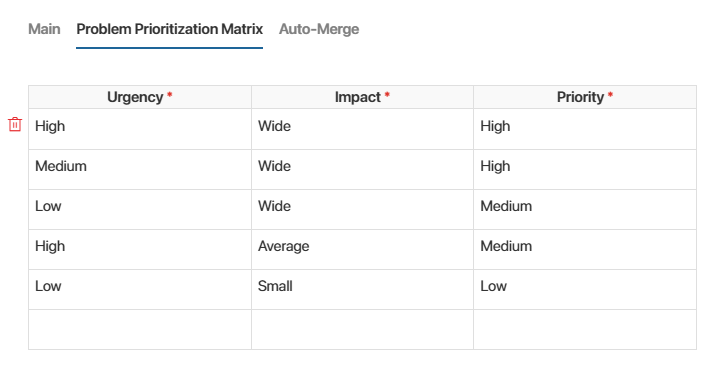
When a user registers a problem, they select the service and enter its urgency and impact. The priority is then assigned automatically based on the prioritization matrix. - On the Auto-Merge tab, you can configure conditions to automatically link similar requests into a master request.
To do this, select Yes in the Use automatic request merging?* field, then specify the merging conditions in the fields that appear:
- Time*. Enter the time window during which requests arrive in the system.
- Time unit*. Select the unit of measurement for the time window: minutes, hours, or days.
- Number of requests to merge*. The minimum number of matching requests required to link them into a single master request.
- Automatic merging rule*. Create or select an item from SD Rules > Rules workspace specifying the request parameters used for merging.
To enable these conditions for requests under this service, ask your system administrator to turn on the Within services option on the Service Desk Settings > Merging Requests page.
Once enabled, if several requests with similar subjects and descriptions are registered for this service within the specified time window (for example, one hour), they will be linked into a master request.
- Click Save.
A new item is then added to the Services app, which you can select when creating a request.
You can also display your available services on the Service Desk external portal by grouping them into catalogs. To learn more, see Service catalogs.