BRIX AI Reads Documents, Transcribes Calls, and Follows Your Company Guidelines
Pass PDFs, images, and meeting recordings to your AI agents. Data enters your process seamlessly without manual entry—and never leaves your secure corporate environment.

BRIX AI continues to evolve as an enterprise platform for corporate AI adoption. In this summer release, we focused on two key areas: expanding the data sources your AI agents can work with and ensuring full control over every single model interaction.
BRIX AI Agents have learned to extract text from images and PDFs, as well as transcribe speech from audio recordings. The recognized content instantly becomes available to the agent as active context—ready to be searched, verified, and passed into downstream workflow steps. All data exchanges with the model are filtered through input and output Guardrails checks, while sensitive data masking is now boosted by your own custom company rules. Smart search has also been upgraded with incremental index updates and full-document context transfer.
What’s new
Image recognition
Extract text from scans, photos, and PDFs using a pluggable OCR provider or a multimodal VLM. Results are instantly fed into the agent's context.
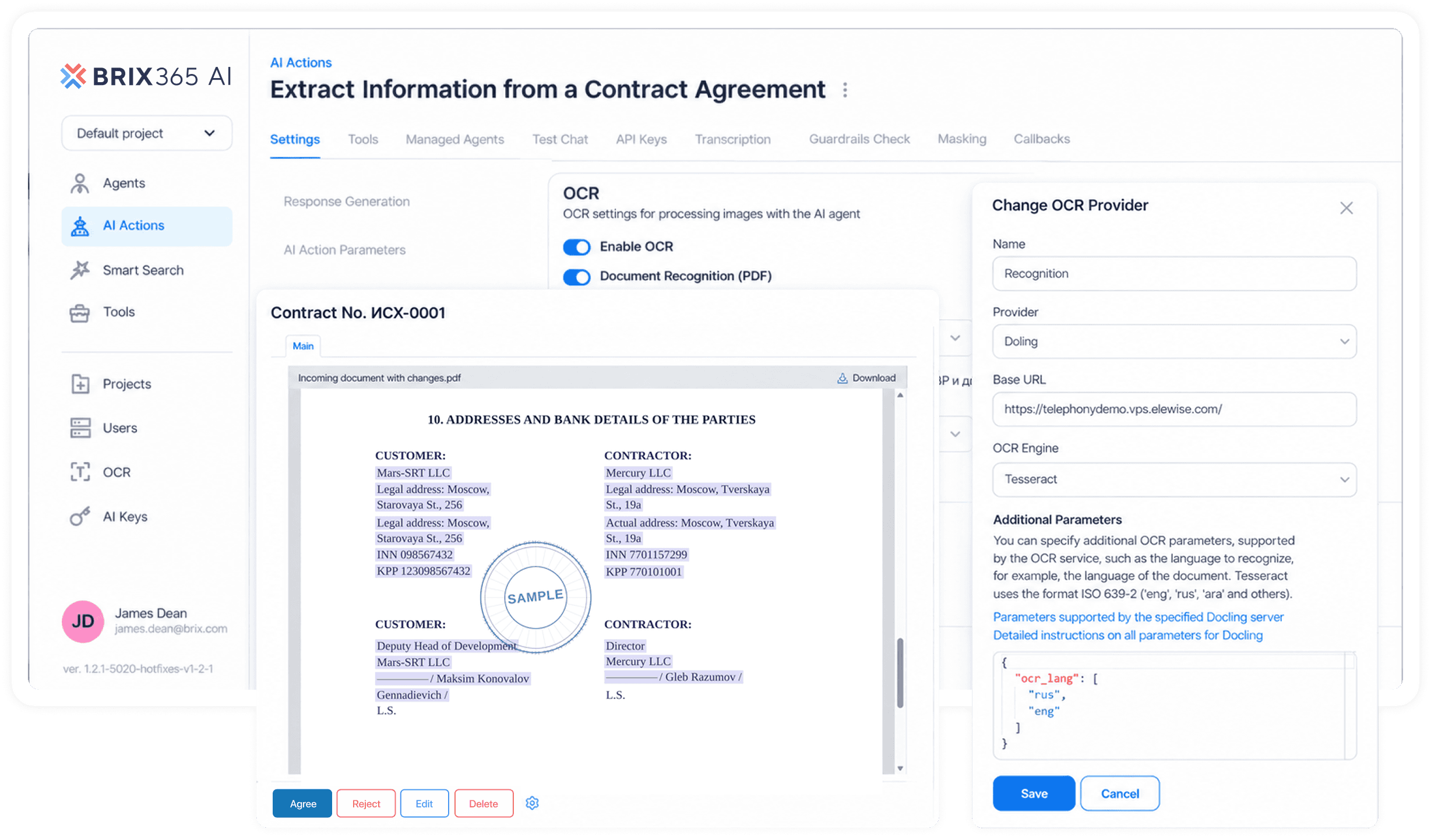
A huge portion of incoming documents arrives as scans, photos, or PDFs. Extracting information from these files usually means tedious manual typing or setting up a separate recognition pipeline, causing delays in business processes.
BRIX AI recognizes images and PDFs via a pluggable OCR provider or a multimodal VLM. The agent extracts the text and describes what’s inside the image. Data becomes available in the agent's context right away: it can be searched, analyzed, validated, and passed to subsequent workflow steps.
Use cases cover your entire incoming document flow. For incoming paperwork, the agent reads scans or PDFs and fills out app pages in BRIX without manual input. When processing invoices, receipts, and delivery notes, it extracts line items and amounts for reconciliation, accounting, and approval. For photos and diagrams, the VLM describes the content so the agent can classify the request, check completeness, and draft a reply. All recognized text is fully indexed and searchable across your archive.
Companies can drastically reduce manual entry at the start of a process, getting structured data from unstructured sources in the exact same format the agent uses for the rest of its context.
Audio transcription
Turn call recordings, interviews, and meetings into text using customizable ASR providers, and feed the results directly into your processes.

Audio recordings of calls, interviews, and meetings remain one of the largest yet least utilized sources of corporate data. Manual transcription takes time, and the results usually end up isolated in separate files outside the actual process.
BRIX AI converts speech to text using customizable Automatic Speech Recognition (ASR) providers. Your company can choose a speech recognition service that fits your specific needs for quality, cost, and data hosting location. No manual transcription or separate file uploads required.
The agent generates meeting summaries considering speaker roles, extracts agreements and assigned tasks, fills in field values in BRIX, and triggers the next process step. Conversation content becomes an active part of your business workflow as soon as the recording is uploaded.
Guardrails verification
Filter every data exchange with an AI agent using an automated check suite—both before sending a prompt to the model and after receiving the response.

Enterprise AI usage requires complete control over both sides of model interaction. On the input side, the goal is to keep unwanted data out of prompts. On the output side, you need to ensure responses comply with company standards.
Every data exchange with an AI agent passes through a suite of Guardrails checks. These checks run prior to sending a prompt to the LLM and right after receiving the output, protecting your workflows from invalid inputs and improper outputs.
Three types of checks are available:
-
LLM-based checks: Evaluate prompts or responses against defined rules (e.g., brand tone of voice, prohibited topics).
-
Regex checks: Find specific patterns like personal data, credit card numbers, stop words, or other restricted text.
-
Webhook calls: Delegate checks to external services, ranging from custom content moderation to internal compliance databases.
The validation mechanism is fine-tuned and optimized so that stringent security requirements won't slow down agent response times. This unlocks new scenarios where AI agents can be safely deployed—from direct client communication to processes with strict internal content policies.
Custom sensitive data masking rules
Complement built-in sensitive data detectors with custom company regex rules.

Data masking in BRIX AI uses dedicated detectors for various entity types, tailored to language nuances. Names and addresses are detected by intelligent text parsers that recognize full name structures regardless of word order, as well as abbreviated forms. Built-in dictionary lookups handle frequent names and surnames, catching edge cases effortlessly. Formal data like phone numbers, tax IDs, social security numbers, passport details, credit cards, and postal codes are recognized using standard format templates with validation checks.
In this summer release, we added custom regex rules on top of built-in detectors. Your company can define its own unique formats—such as internal identifiers, contract numbers, or system codes. All matches are replaced with placeholders before the prompt is sent to the model.
Personal data, payment details, and internal IDs stay securely inside your company boundary, helping you meet internal compliance and data protection guidelines while leveraging AI.
Smart search enhancements
Update indexes incrementally and pass full document texts into the model context.

As indexed data grows, performing full re-indexing of data sources becomes expensive in terms of time and system resources. Additionally, fragmented context—where the model only sees a small snippet of a document—can hurt response accuracy.
BRIX updates data sources incrementally: only modified records are re-indexed, significantly speeding up synchronization. The indexing engine itself has been deeply optimized. Full document texts are now passed into the LLM context, and overlapping chunks during retrieval are merged to eliminate duplicates and gaps in search results. Furthermore, the smart search tool now features clear text descriptions so agents know exactly when and how to apply it.
Search runs on up-to-date data, and agent answers are backed by complete document context. Smart search remains lightweight and effective even on massive enterprise datasets where full re-indexing is too costly.
Pre-built AI agents across BRIX products
In the summer release, pre-built agents ship out of the box with BRIX Procurement and BRIX Service Desk. Each agent covers a specific process bottleneck where decision-making normally requires sifting through large volumes of scattered data.

Procurement uses two scenarios:
The Price & Terms AI Advisor interactively suggests commercial terms for document categorization based on historical purchasing data and verified external sources, helping you locate active contracts or build a supplier shortlist for RFQs. Working alongside it, the Proposal Analysis Agent compares supplier quotes directly against your technical specifications and procurement requirements. It highlights line-by-line matches and discrepancies to generate actionable recommendations for buyers and technical experts, while leaving full final approval in human hands.
Technical support uses three scenarios:
The Resolution AI Agent identifies the core issue in unstructured requests, finds solutions across knowledge bases and resolution histories, and performs automated actions right on the ticket. To streamline incoming workflows, the Classification AI Assistant determines ticket categories based on thread context, creates the ticket, and routes it to the right team along with compiled background details. Finally, the Context Gathering Agent automatically fetches and displays relevant auxiliary data on the ticket page so operators have everything they need to resolve issues faster.
All scenarios can be further tailored within BRIX AI to match your exact company processes.