If requests related to certain issues have been recorded before or occur regularly, you can register a problem based on them.
A new problem can be created in the following ways:
- Mark requests with the same issue and perform the Combine into a problem bulk action. For more details, see the Combine requests into a problem article.
- On the item page, click the
 icon on the top toolbar.
- In the CMDB app item, click the Register Problem button. For more details, see the CMDB page article.
- In the Problems app, click the + Problem button in the upper right corner.
In each case, the problem creation window will open, where you need to fill in the fields.
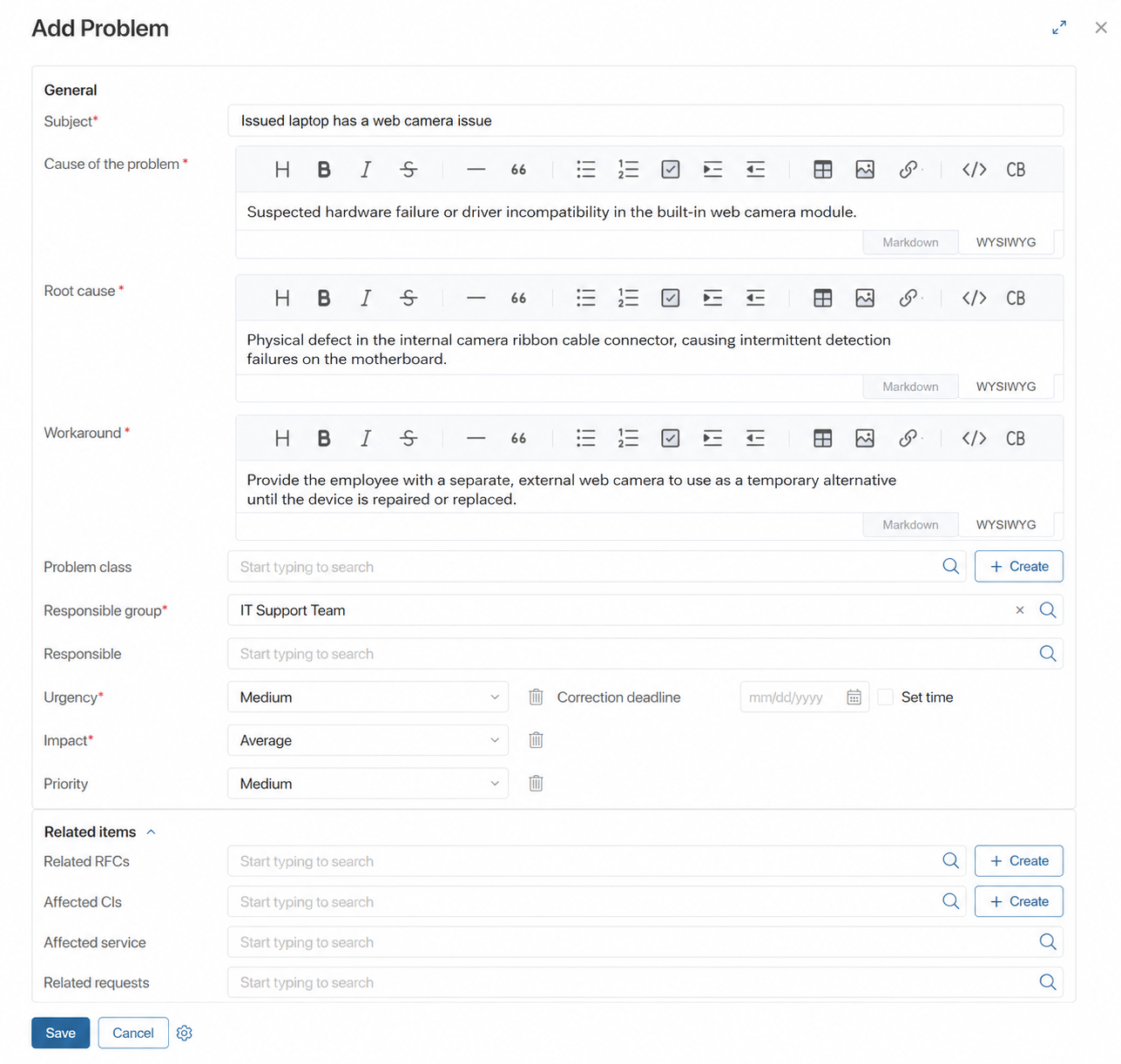
General section:
- Subject*. A brief description of the issue.
- Cause of the problem*. The suspected or confirmed cause of the problem.
- Root cause*. The primary source of the malfunction that was discovered as a result of analyzing the problem. Once this is resolved, the problem will not recur.
- Workaround*. Actions taken to prevent the problem from occurring.
- Problem class. The category the problem belongs to. The value is selected from the Problems Classes directory. You can also add a new class by clicking + Create.
- Responsible group*. Specify who will be responsible for resolving the problem. Select a user, user group, or org chart item.
- Responsible*. The employee responsible for resolving the problem.
- Urgency*. Select the urgency for resolving the problem: Low, Medium, or High.
- Correction deadline. The time by which the problem should be resolved.
- Impact*. Select the level of impact the problem has on users: Wide, Average, or Small. This helps the responsible employee determine the priority of the problem.
- Priority. The urgency of resolving the issue: High, Medium, or Low.
If the problem affects a service for which a problem prioritization matrix has been defined, the priority will be calculated automatically based on the selected urgency and impact values. In this case, it cannot be changed.
Related items section:
- Related RFCs. Select from the list the change requests for hardware or software configuration that caused the problem. The list of all available requests is stored in the RFC app. To add a new request, click the + Create button.
- Related CIs. Specify the assets affected by the problem. The list of available configuration items (CIs) is stored in the CMDB app. To add an asset, click + Create.
- Affected service. Specify the service for which the client reported the problem.
- Related requests. Select the requests caused by the problem. Values are taken from the Requests app.
Click Save.
The problem will be recorded in the system with the New status. The assigned employee can then take it into work.