An infrastructure is a set of components necessary for operation of the BRIX application. Depending on the objectives, the approaches and requirements for organizing an BRIX On-Premises infrastructure differ.
Let’s take a look at the following infrastructure organization options:
- Development/test environment infrastructures.
- Production environment infrastructures.
- High availability production environment infrastructures.
Начало внимание
You can choose one of the infrastructure organization options.
Конец внимание
Development/test environment infrastructures
This infrastructure organization option is suitable for development and test environments and does not require the increased reliability of storage components.
- Environment with Internet access.
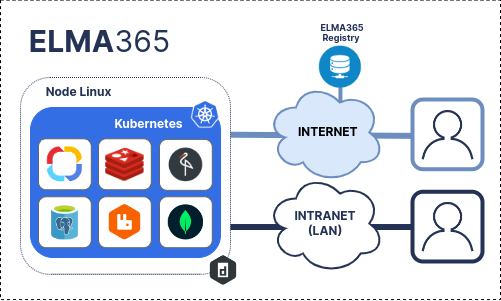
Characteristics:
- One physical server or virtual machine for all components.
- Installation with Internet access.
- Embedded storage data components.
For more information on how to deploy this type of infrastructure, read the following articles:
- Environment without Internet access.
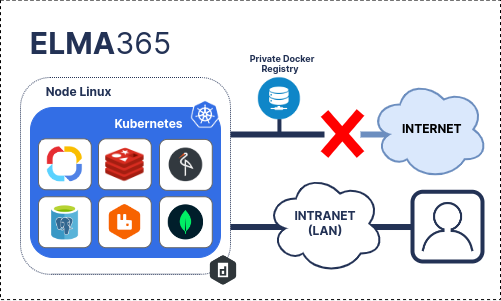
Characteristics:
- One physical server or virtual machine for BRIX On-Premises and data storage components.
- One physical server or virtual machine for Kubernetes image storage.
- Installation without Internet access.
- Local Kubernetes image storage.
- Embedded data storage components.
For more information on how to deploy this type of infrastructure, see:
- Install Harbor.
- Download BRIX images.
- Download Deckhouse images.
- Kubernetes cluster.
- Prepare embedded databases.
- Install BRIX in Kubernetes.
Production environment infrastructure
A variant of infrastructure organization for operational environments (Production).
- Environment with Internet access.
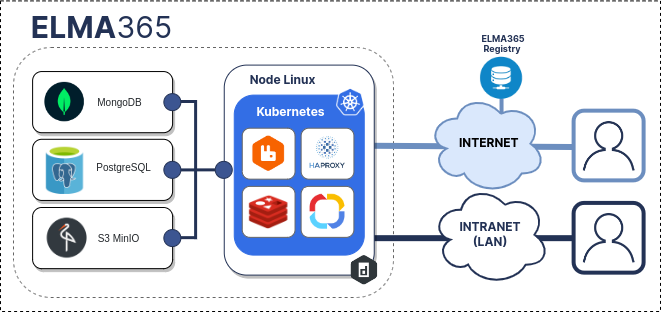
Characteristics:
- One physical server or virtual machine for BRIX On-Premises, proxying and storage components.
- Three physical servers or virtual machines for external databases.
- Installation with Internet access.
- Embedded RabbitMQ and Valkey or Redis data storage components.
- External MongoDB, PostgreSQL, and S3 MinIO data storage components.
- Embedded HAProxy proxy server for proxying incoming requests to external S3 storage.
For more information on how to deploy this type of infrastructure, see:
- MongoDB.
- PostgreSQL.
- MinIO S3.
- Kubernetes cluster.
- Prepare embedded databases (install RabbitMQ and Valkey or Redis).
- S3 proxying in Kubernetes via S3-Gateway.
- Proxying databases in Kubernetes via DB-Gateway.
- Install BRIX in Kubernetes.
- Environment without Internet access.
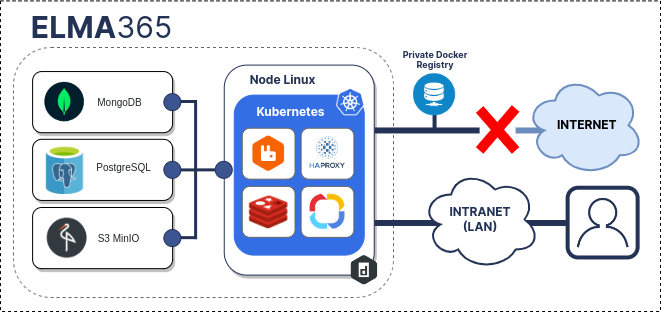
Characteristics:
- One physical server or virtual machine for BRIX On-Premises, proxying and storage components.
- Three physical servers or virtual machines for external databases.
- One physical server or virtual machine for Kubernetes image storage.
- Installation without Internet access.
- Local Kubernetes image storage.
- Embedded RabbitMQ and Valkey or Redis data storage components.
- External MongoDB, PostgreSQL, and S3 MinIO data storage components.
- Embedded HAProxy proxy server for proxying incoming requests to external S3 storage.
For more information on how to deploy this type of infrastructure, see the following articles:
- Install Harbor.
- Download BRIX images.
- Download Deckhouse images.
- ֿKubernetes cluster.
- Prepare embedded databases.
- Install BRIX in Kubernetes.
High availability production environment infrastructure
The infrastructure organization option is suitable for operational environments (production) with high reliability requirements for storage components.
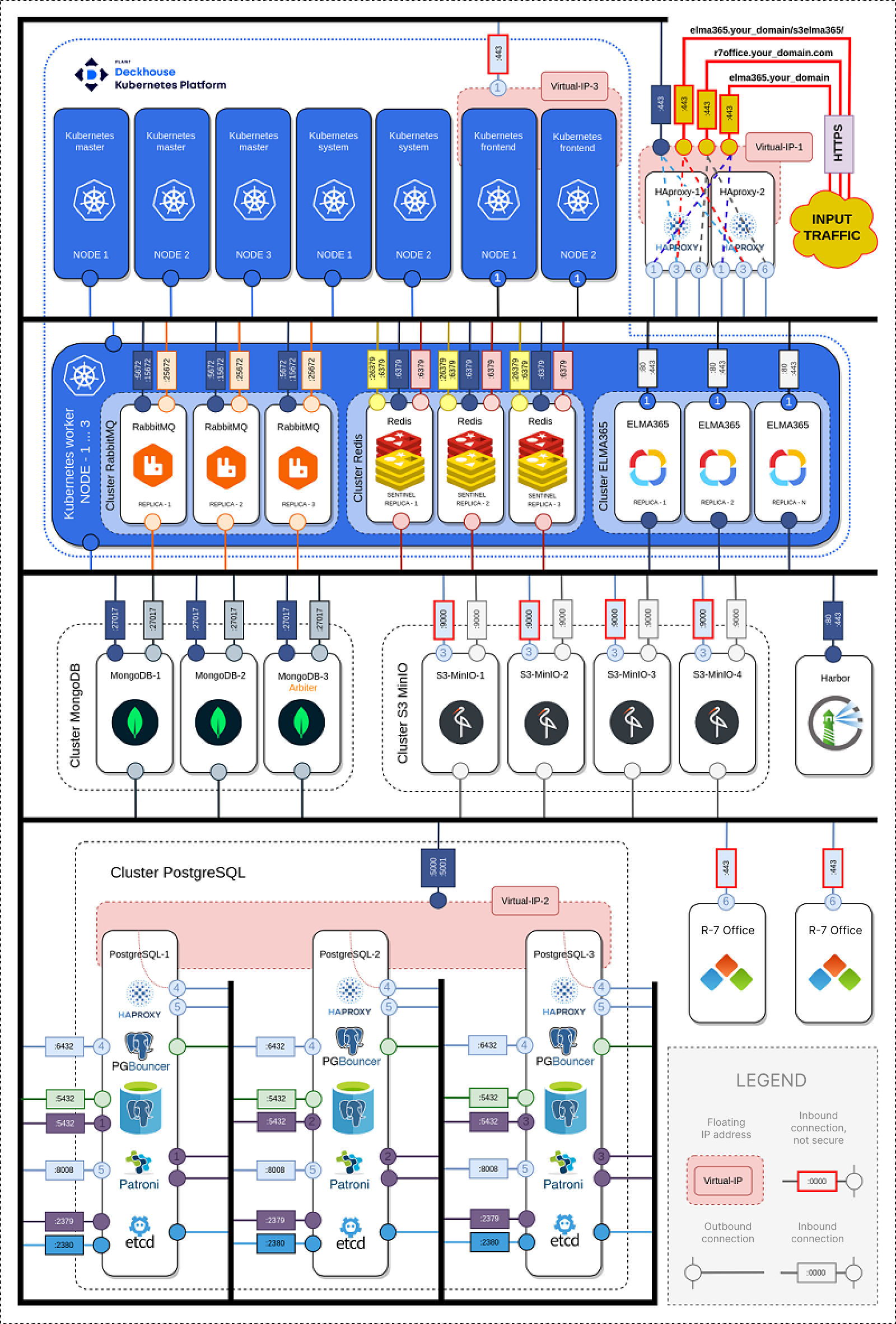
Characteristics:
- 10 physical servers or virtual machines for the Kubernetes cluster that will host BRIX On-Premises and data storage components.
- 10 physical servers or virtual machines for external databases.
- Two physical servers or virtual machines for balancing and proxying incoming requests to BRIX On-Premises and S3 storage.
- One physical server or virtual machine for Kubernetes image storage.
- Installation without Internet access.
- Local Kubernetes image store.
- Embedded high availability RabbitMQ and Valkey or Redis data storage components.
- External high availability MongoDB, PostgreSQL, and S3 MinIO data storage components.
- External high availability HAProxy proxy server for proxying incoming requests to BRIX On-Premises and S3 storage.
For more information on how to deploy this type of infrastructure, see:
- Install Harbor.
- Download BRIX images.
- Download Deckhouse images.
- MongoDB cluster.
- PostgreSQL cluster.
- MinIO cluster.
- High-availability Kubernetes cluster.
- Prepare embedded databases (install RabbitMQ and Valkey or Redis).
- High availability HAProxy.
- Install BRIX in Kubernetes.