This article describes the features, steps, and consequences of two operations:
- Deleting a solution. The solution ceases to exist as a single set of combined components, but its workspaces, pages, and modules remain in the system.
- Deleting a component from a solution.
Deleting and changing solution components is available both for custom solutions developed in your company and for business solutions imported from a .e365 file. A business solution can be deleted if it is unlocked and not paid.
Only a system administrator can perform deletion.
Delete a solution
You can delete a solution that combines certain components, for example, to include them in another custom solution. Deleting a solution does not remove its components from the system. You can continue working with them as usual, hide them, or delete them individually.
After deletion:
- For a custom solution, you will not be able to export it as a single set of components.
If necessary, you can reassemble the components into a solution. If you set the same code for it as for the deleted one, the solution update mechanism will continue to work.
- For a ready-made business solution, you will not be able to update it to a new version.
If necessary, the solution can be re-imported into the company. In this case, its components will be updated.
Steps to delete a solution
- Proceed to delete in one of two ways:
- On the Administration > Manage Solutions page, in the solution card, click the three dots icon and select Delete.
- On any system page, in the left menu, click the wrench icon
 and go to the Solutions tab in the window that opens. Next, to the right of the solution name, click Settings and select Delete.
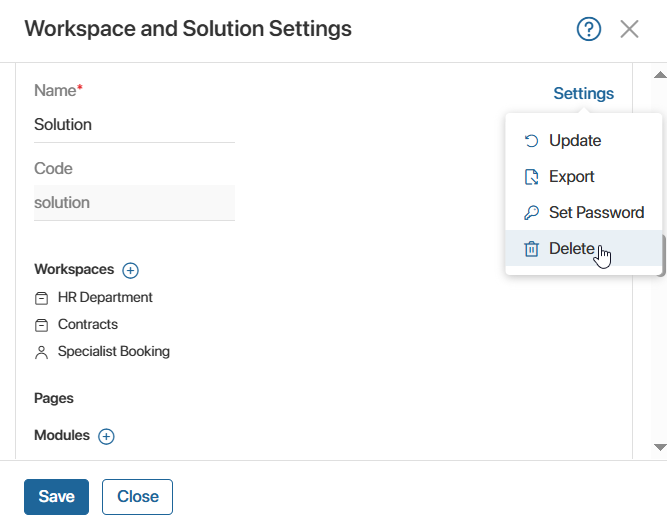
- In the window that opens, confirm the action.
A solution cannot be restored, but you can re-combine the components into a new solution.
Delete a component from a solution
A workspace, page, or module may become irrelevant for the operation of a custom solution or may not be used in the company where the solution was imported. We do not recommend removing such components from a solution. This breaks the integrity of its structure and can cause errors:
- Duplication of components during subsequent updates of the imported solution.
- Failures during solution export, import, and updates.
- Loss of links in optional dependencies between solutions.
Instead of removing components from a solution, hide the workspace or page from the left menu so they do not appear for users, or disable the module on its page.
If removing a component from a solution is necessary, take preparatory steps to ensure proper operation.
Prepare to remove a component from a solution
Before removing a component from a solution and discontinuing its use:
- Check for internal links to the component being removed within the solution and update them. For example, if a field in a business process of another workspace references an app in the workspace being removed, replace that field.
- Check optional dependencies on the component being removed in scripts of other components. For example, if an API method is configured in the module being removed and is called from a script in a workspace process, the configured action will stop working after deletion.
Steps to delete a component from a solution
- Proceed to delete components from the solution in one of the following ways:
- On the Administration > Manage Solutions page, select the solution card, then on the page that opens, click the trash can icon next to the component name.
- On any system page, in the left menu, click the wrench icon and go to the Solutions tab in the window that opens. Find the required solution and click the trash can icon next to the component name.
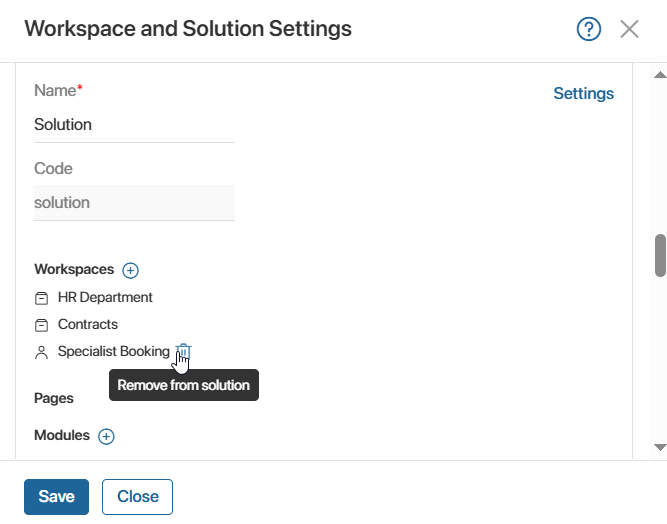
- Save the changes.
To be able to add the component back to the solution if issues arise, we recommend not deleting it from the system. Hide the workspace or page from the left menu or disable the module.
Please note that if you remove components from a developed solution and then export it, when updating the solution in another BRIX instance, the components will not be deleted from the system. They will not be included in the solution, but will remain available to users.